
Four-Point Probes
Description
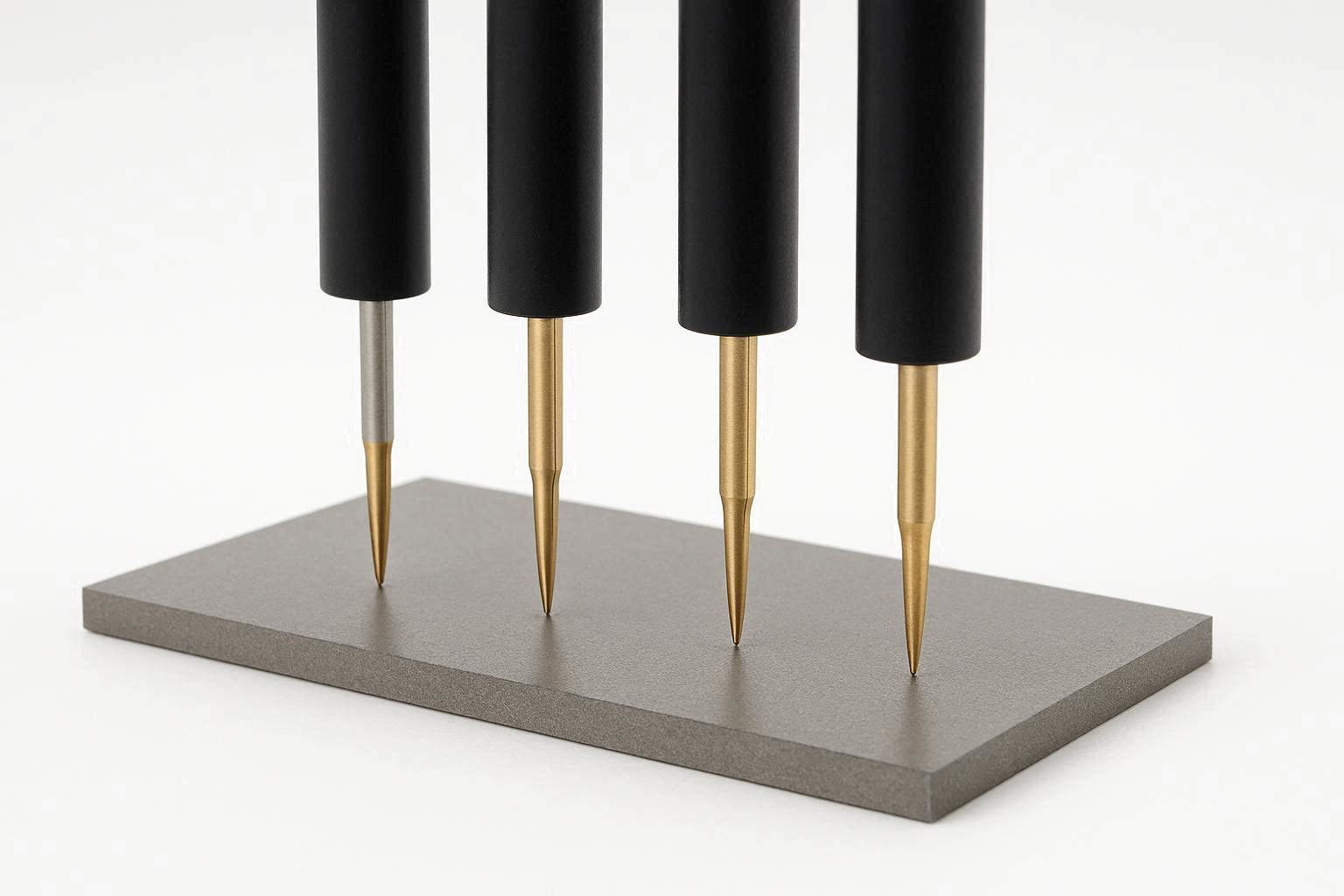
What is a Four-Point Probe?
A Four-Point Probe consists of four equally spaced, precise probes arranged linearly. Two outer probes source a current through the material, while the two inner probes measure the resulting voltage drop. This configuration eliminates contact resistance effects, providing highly accurate electrical measurements.
Key Components of Four-Point Probe:
- Four sharp, fine-tipped probes
- Precise positioning system
- Source meter or current source
- Voltmeter or multimeter
How it works:
- A current is applied through the outer probes.
- The voltage drop is measured across the inner probes.
- The resistance or resistivity is calculated from the current and voltage data using standardized formulas.
Key Features of Four-Point Probes:
- High Accuracy: Eliminates contact and lead resistance errors.
- Versatile: Suitable for various materials, including thin films and bulk samples.
- Adjustable Probe Spacing: For different measurement scales.
- Automated and Manual Models: For laboratory or industrial use.
- Temperature Control Options: For temperature-dependent measurements.
Common Applications of Four-Point Probes:
- Semiconductor Characterization: Measuring wafer resistivity and sheet resistance.
- Material Research: Studying electrical properties of new materials.
- Thin Film Analysis: Assessing coatings and conductive layers.
- Quality Control: Monitoring production consistency in electronics manufacturing.
- Research & Development: Investigating conductivity changes with temperature, doping, or treatments.
Advantages of Four-Point Probe Measurements:
- Exceptional Precision: Minimizes contact resistance effects.
- Non-Destructive Testing: Preserves sample integrity.
- Fast & Reliable: Suitable for high-throughput testing.
- Wide Material Compatibility: From semiconductors to conductive polymers.
Key Value Propositions of Four-Point Probe:
- Exceptional Metrology Precision: Achieves < 0.1% (1σ) measurement repeatability via high-impedance electrometers and ultra-stable UHP current sources.
- Contamination & Damage Control: Features adjustable low-force probe heads (down to 20g) and ISO Class 1 cleanroom-compatible components to ensure zero-defect processing.
- Optimized Cost of Ownership (COO): Kinematic "Plug-and-Play" probe head mounts allow for field replacement in under 15 minutes, maximizing tool up-time.
- Advanced Mapping Analytics: Real-time generation of 2D contour maps and 3D surface plots for instant visualization of cross-wafer process uniformity.
- Fab Automation Ready: Full compliance with SEMI E5/E30 standards (SECS/GEM) for seamless host communication and automated recipe execution.
Technical Deep-Dive
- The system utilizes a collinear four-electrode geometry to decouple contact resistance from the measurement circuit, ensuring absolute accuracy on both highly conductive metals and low-dose implants.
- Probe Material Science: Standard Tungsten Carbide (WC) or Osmium-tipped probes are available to match the hardness and sensitivity of the target film.
- Wafer Handling: Fully automated handling for 300mm FOUPs or 200mm SMIFs, featuring high-accuracy pre-aligners for precise coordinate-based mapping.
- Material Compatibility: Verified for Si, GaN, SiC, and a wide array of metallic PVD/CVD films including Cu, Al, and TiN.
- Technical Drawings: [Placeholder: Request CAD Previews for EFEM Layout Integration].
Buyer’s Guide / Decision Logic
When evaluating a 4PP system, consider these critical process parameters:
- Dynamic Range: Ensure the electrometer resolution matches your process—high-dose implants require low-range sensitivity, while USJ (Ultra-Shallow Junctions) require high-range stability.
- Contact Geometry: Choose your probe pitch (e.g., 1.0mm vs 0.5mm) based on your device feature density and the "edge exclusion" requirements of your metrology plan.
- Thermal Stability: For precise resistivity measurements, the system must include integrated temperature compensation algorithms to normalize data to 25°C.
Technical FAQ
Q: What is the Mean Time Between Failures (MTBF) for the probe assembly?
A: Our probe heads are rated for >750,000 touchdowns. We recommend a automated daily "gold standard" check to monitor tip wear and ensure calibration stability.
Q: Does the software support "Virtual Probe" mapping?
A: Yes, our proprietary software allows users to define custom polar or rectangular grids with up to 1,000+ points for high-definition uniformity analysis.
Q: Is the system SEMI S2/S8 certified?
A: Absolutely. All systems are shipped with third-party certification for SEMI S2 safety and S8 ergonomics standards, including EMO circuitry and interlocked panels.
Q: How does the system handle high-resistivity measurements?
A: The "Ultra" series utilizes an active guarding technique to eliminate leakage currents, allowing stable measurements up to 100 MΩ/sq.
Q: Can I integrate this into an existing MES?
A: Yes. The onboard SECS/GEM interface allows for full remote control, data collection (spooling), and alarm management by your factory host.
In the fabrication of advanced logic and memory devices, precision monitoring of ion implantation and thin-film uniformity is non-negotiable for high-yield outcomes. Our Four-Point Probe (4PP) systems provide high-speed, non-destructive sheet resistance mapping that empowers process engineers to detect furnace or implanter excursions in real-time. By combining sub-angstrom-level contact sensitivity with high-throughput automation, these tools bridge the gap between R&D accuracy and the rigorous demands of 24/7 high-volume manufacturing.
Interactive Selection Table: System Configurations
| Model No. | Wafer Size | Throughput (WPH) | Measurement Range | Primary Application |
|---|---|---|---|---|
| FPP-200 R&D | Up to 200mm | < 12 (Manual) | 1 mΩ/sq – 10 MΩ/sq | Failure Analysis / Lab Use |
| FPP-300 Fab | 200/300mm | 45 - 60 | 5 mΩ/sq – 5 MΩ/sq | Power Semi / Analog HVM |
| FPP-300 Ultra | 300mm | > 90 (Dual EFEM) | 0.5 mΩ/sq – 100 MΩ/sq | Advanced Node Foundry |
| FPP-ThinFilm | Up to 300mm | 35 - 50 | 1 mΩ/sq – 800 kΩ/sq | Metal PVD / ECD Control |
Request a Technical Consultation to discuss your specific sheet resistance mapping requirements or Get a Quote for Custom Configuration.
Order Form
About Semiconductor Electronics
SEMI EL project is a global supplier of materials, equipment, spare parts and supplies for the semiconductor industry.
Get In Touch
Email: info@semi-el.com